
by Cynthia Germain
We are often told to plan for retirement as a financial milestone…save enough, pay off the house, choose the right time. What we talk about far less is what happens after the job title, the daily routines, and personal validation disappear.
A recent Wall Street Journal article put words to something many older adults tell me all the time, often quietly and sometimes with a bit of surprise: “I didn’t expect retirement to feel like this.” Not exactly bored exactly, not necessarily unhappy, just untethered.
Work, whether paid or unpaid, does more than fill time. It gives structure to our days and meaning to our skills. It offers positive feedback as people rely on you, seek your opinion, or thank you for showing up.
When that ends abruptly, even by choice, many retirees experience a subtle but real loss: the feeling of mattering. Not being busy enough is one thing. Not feeling useful is a whole other thing. And this isn’t about ego, it’s about identity. Decades of experience don’t simply shut off at 65 or 70. Skills don’t have an expiration date. In fact, judgment and perspective often get sharper with time. Yet too often, retirement culture sends an unspoken message: You’ve done your part so now step aside.
What struck me most in the article was how common this experience is and how rarely it’s discussed before retirement happens. We prepare people for income changes, healthcare decisions, even travel dreams. We don’t prepare them for the emotional gap that can open when contribution is no longer expected. And when people don’t feel needed, the effects ripple outward:
- Social connections shrink
- Confidence erodes
- Motivation dips
- Isolation quietly grows
This is especially true in communities like Door County, where many people retire to the area, leaving behind professional networks but not necessarily finding new ways to plug in. That leaves an important question for communities like ours: What do we do with all of this experience once people step away from full-time work?
At Do Good Door County, we don’t see this as a problem of idle time. We see it as a missed opportunity for connection and contribution. When experience goes unused, it’s not just the individual who loses a sense of purpose, the community loses valuable skills and hard-earned wisdom.
That thinking is what’s behind M², a mentorship initiative we are beginning to shape in collaboration with the Door County Economic Development Corporation. M² is not a finished program yet. Right now, we’re recruiting a planning committee to help co-create the framework, bringing together people who want to think about how experience, skills, and perspective are shared in ways that feel meaningful.
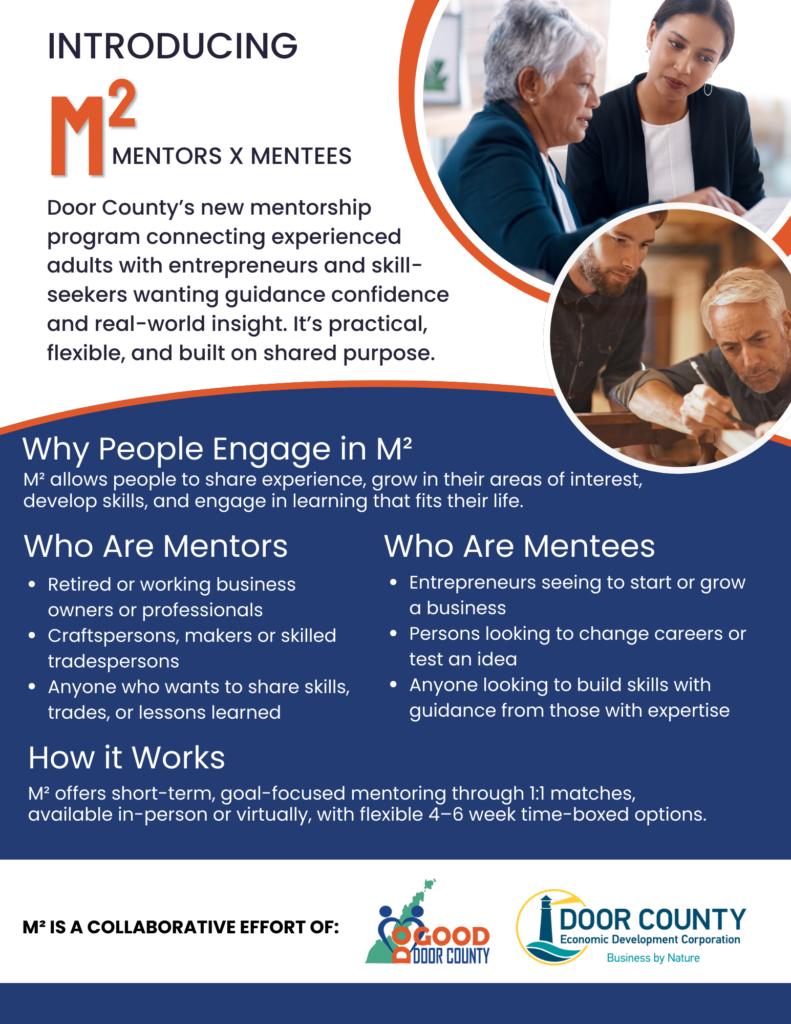
The goal isn’t to recreate work or fill calendars. It’s to create opportunities for people to matter and to have their experience make a difference again. When mentoring is approached this way, it benefits both sides. It affirms the value of lived experience while supporting those who are building businesses, changing careers, or simply wanting to learn new skills.
We’re aiming to launch M² in June 2026, but the most important work is happening now, building something together that reflects the values of Door County. Because retirement shouldn’t quietly signal the end of contribution. With intention and collaboration, it can open the door to a different and rewarding way of continuing to matter.
Interested in being on the ground floor of this important initiative? Contact us at dogooddoorcounty@gmail.com.