

by Cynthia Germain
Most of us have too much stuff.
I say that knowing full well that I am included in the “most of us.” We accumulate things slowly…a box here, file folders there, clothes we might wear again, things our children might want someday, and things we keep because they remind us of someone or someplace important to us.
And before long, our homes are holding not just our possessions, but decades of our lives.
That is what makes decluttering so much more complicated than simply cleaning out a closet. Our things tell stories. The dishes belonged to our mother. The old tools were our father’s. There are photographs of people whose names perhaps only we remember. There is furniture we have moved from house to house because someone gave it to us, and boxes we haven’t opened in years but still can’t quite bring ourselves to give away.
There is nothing particularly wrong with any of that.
And clutter is not the same thing as hoarding. We sometimes use the word “hoarding” casually to describe someone who has a lot of things, but they aren’t interchangeable. Hoarding involves persistent difficulty discarding possessions to the point that the accumulation can interfere with the ability to use living spaces. Having an overfilled basement, too many clothes or several boxes you have been meaning to go through is something many of us experience.
But as we age, there are some good reasons to take another look at all that stuff. We often think of decluttering as something people do when they are preparing to move. I think we should also look at it as something we can do when we are preparing to stay.
The AARP has prepared a presentation, Downsizing and Decluttering, that points out that our homes need to change with us. We may need clearer pathways through rooms. We may eventually use a walker or another mobility device. There may come a time when someone needs to provide care or assistance in our home. Too much furniture and too many things can make all of that more difficult.
So perhaps decluttering is less about having a tidy house and more about making sure our house continues to work for us.
The trouble, of course, is getting started.
One suggestion I particularly like is the 10-minute sweep. Don’t decide that you are going to clean the basement. That’s enough to make most of us find something else to do. Pick a very small area and give it ten minutes. Then do it again another day.
There is also the simple four-pile approach: keep, sell, donate and trash. And when something comes into the house, consider whether something else can go out.
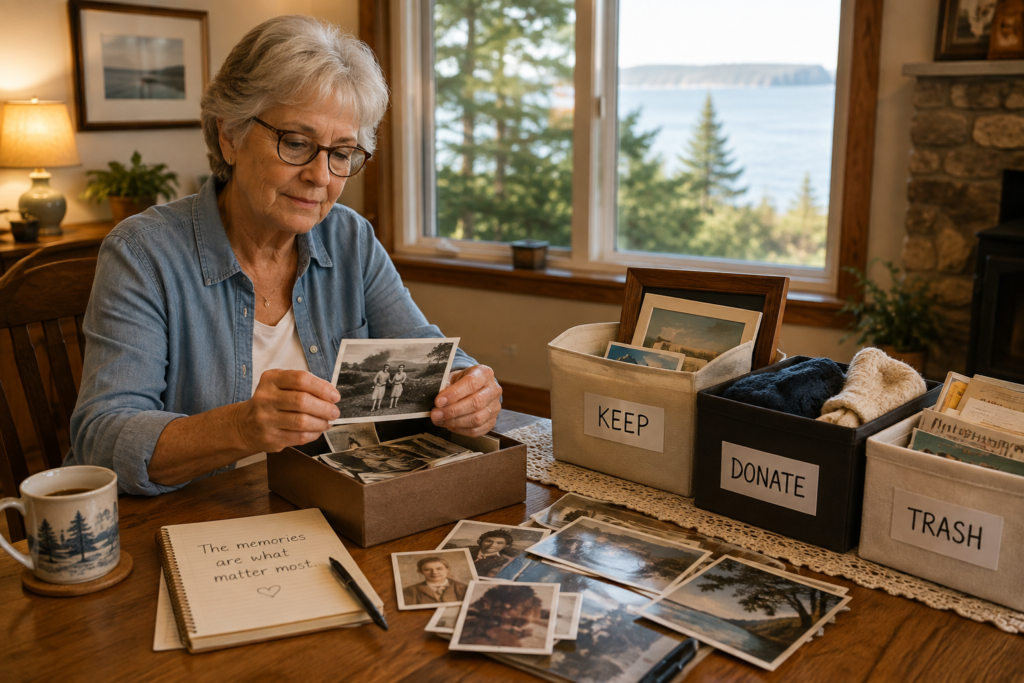
Then there are the things we are saving for our children and grandchildren. This may require a conversation.
We can become so attached to the story behind an object that we assume the next generation will feel the same way. Sometimes they do. Sometimes they don’t. The presentation has a wonderful term for pushing possessions onto the next generation that they really don’t want: “punting.” Instead of assuming, ask. And if someone doesn’t want the china, the furniture or the collection we have carefully saved for them, perhaps we need to allow that to be okay.
For the things they do want, why not consider giving some of them away now? There is something rather nice about being able to see another person use and enjoy something that has been meaningful to us.
Photographs may be the best example of all. We can keep boxes and boxes of photographs, but if we are the only person who knows who is in them, what happens to those stories someday? Maybe keeping fewer photographs and writing down the names and the stories behind the important ones is a greater gift than leaving someone thousands of unidentified pictures to sort through.
That gets to what I think is the heart of decluttering. The memory isn’t the thing. The people, experiences and stories of our lives matter. Our possessions can help us remember them, but we don’t necessarily need every possession in order to keep those memories.
Maybe decluttering doesn’t have to begin with asking what should I get rid of? Maybe a better question is what do I want to make room for? Room to move. Room for help if we someday need it. Room for the people we enjoy. Room to continue living comfortably in the place we call home. And perhaps a little less stuff to worry about along the way.
Upcoming Downsizing & Decluttering Presentations
I will be presenting AARP’s Downsizing and Decluttering: You Can’t Take It With You at several locations around Door County. The program explores why our possessions can be so difficult to part with and offers practical, manageable ways to begin decluttering.
August 25 — Baileys Harbor Town Hall, 10:30 a.m.
August 26 — Shepherd of the Bay Lutheran Church, Ellison Bay, 10:30 a.m
September 17 — ADRC, Sturgeon Bay, 1:00 p.m.
October 6 — NWTC, Sister Bay, 10:30 a.m.
October 21 — Belgian Heritage Center, Brussels, 10:30 a.m.
If you’ve been thinking about tackling a closet, a basement, a lifetime of photographs or simply wondering where to begin, I hope you’ll join us.
Enjoying our blog? Support our mission by helping to turn ideas into action. Your donation to Do Good Door County supports programs and collaborations that reduce isolation, strengthen connection, and help make communities in Door County more livable for all.